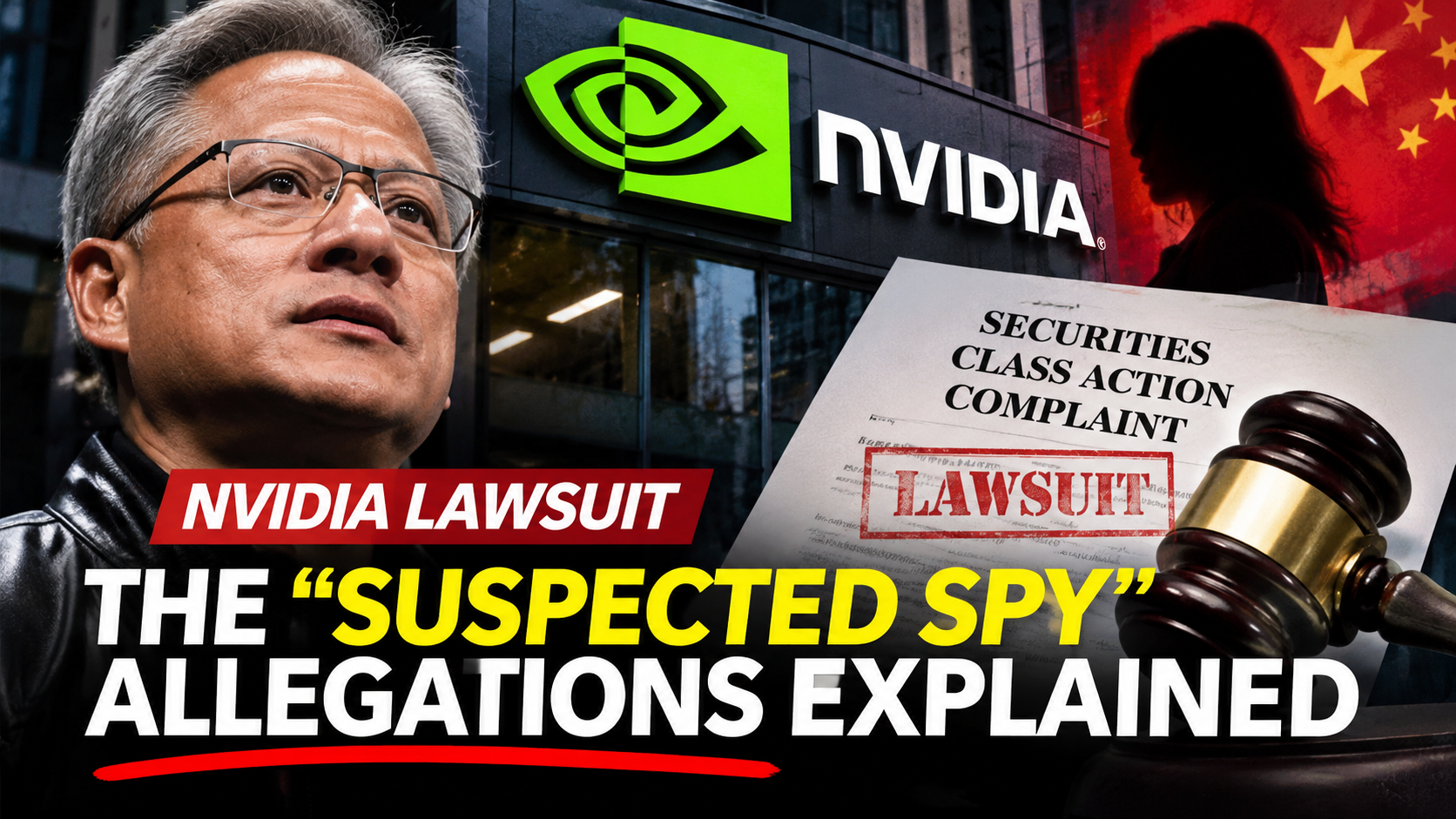
Nvidia’s $190 Billion Wipeout: The Lawsuit, the FBI, and the “Suspected Spy” Nobody Disclosed
By the Cyber Law Institute editorial team | Published November 13, 2026 | 11-minute read
Every claim below is an allegation unless a court or agency says otherwise. See our editorial standards, methodology, and legal disclaimer. This article is not legal or investment advice.
On Sunday, November 8, 2026, Nvidia’s board did something rare for the world’s most valuable chipmaker. In a six-sentence statement, it announced an independent investigation into the company’s own founder and CEO. Within a day, a shareholder had sued. Within the week, the President said the FBI was looking into the matter, three House committee chairs asked Jensen Huang for a closed-door briefing, and law enforcement officials told CBS News that the Justice Department’s National Security Division is examining a Singapore-linked chip distributor over possible export-control breaches.
This is not only corporate drama. It sits where securities fraud, export controls, insider risk, and board oversight meet. Below, we explain what is alleged, what plaintiffs must prove, and what enterprise legal and compliance teams should do now. For our wider coverage, see Lawsuits & Settlements and the Latest News hub.
Key Takeaways
- The case: Kistenmacher v. NVIDIA Corporation, No. 5:26-cv-13448 (N.D. Cal.), alleges securities fraud on behalf of investors who bought Nvidia securities between October 9, 2025 and November 8, 2026.
- The market reaction: Shares fell $7.97, or 4.27%, to $178.67 on the first trading day after the board’s announcement, roughly $190 billion in market value by one estimate.
- Beyond securities law: Reported DOJ, FBI, and congressional attention raises export-control and national-security questions.
- Nvidia’s position: The board says it has no reason to believe company secrets were compromised, and Huang says he will cooperate fully.
- Nothing is proven: The complaint is untested, and a falling stock price does not by itself establish fraud.
How the Controversy Unfolded
- October 9, 2025: The New York Times first reports on Huang socializing in Taiwan with Alice Huang, an executive at Megaspeed, according to Associated Press reporting. The complaint’s class period begins on this date.
- November 8, 2026: Nvidia’s board announces an independent investigation, citing reports that Huang was the target of a foreign intelligence effort. A committee of independent directors, assisted by outside counsel, will oversee it.
- November 9: On the first trading day afterward, shares drop 4.27%. The complaint is filed shortly after the market closes, and President Trump says the FBI is looking into the affair.
- November 10: Nvidia says its independent directors retained Wachtell, Lipton, Rosen & Katz, per Insurance Journal. Huang’s letter says he supports the investigation and will cooperate fully.
- November 17: Nvidia reports third-quarter results.
- November 18: Three House committee chairs have asked Huang to attend a closed-door briefing.
Huang reportedly acknowledged an intimate relationship with Alice Huang to the board and company by email, according to TweakTown. The board has said it has no reason to believe company secrets were compromised.
What the Complaint Alleges
The suit was filed by retail investor Mark Kistenmacher through The Rosen Law Firm in federal court in San Jose. According to TechCrunch, he made seven purchases totaling roughly $20,500 between February and November 2026. The complaint accuses Nvidia and Huang of violating federal securities laws, including Rule 10b-5, and seeks unspecified damages. It describes Alice Huang as a “suspected Chinese spy,” a characterization that is the complaint’s own and has not been tested in court, per PPC Land’s detailed account.
The core theories, as reported, are:
- Undisclosed ties. Investors were allegedly not told about a relationship between the CEO and an executive at a company in Nvidia’s distribution ecosystem.
- A mischaracterized distributor relationship. The suit claims Nvidia mischaracterized its relationship with a Singapore-based chip distributor, as summarized by Gadget Review.
- Concealed national-security risk. Nvidia allegedly misled investors by hiding national-security risks linked to the CEO’s personal conduct.
As of the reporting we reviewed, neither the board statement nor the complaint contains a response from Nvidia to the lawsuit.
The Legal Framework: What Plaintiffs Must Prove
Most securities class actions like this one rest on Section 10(b) of the Exchange Act and SEC Rule 10b-5, which prohibit material misstatements and misleading omissions in connection with buying or selling securities. A plaintiff generally must plead and ultimately prove six elements: a material misrepresentation or omission, scienter (intent or severe recklessness), a connection to a securities transaction, reliance, economic loss, and loss causation. Huang also faces exposure as an alleged control person under Section 20(a).
Three doctrines will shape the case.
1. Pleading rigor. The Private Securities Litigation Reform Act requires complaints to specify each allegedly misleading statement, explain why it misled, and plead facts giving rise to a “strong inference” of scienter. In Tellabs v. Makor, the Supreme Court held that the inference must be cogent and at least as compelling as any innocent explanation. Expect Nvidia’s lawyers to invoke this standard in a motion to dismiss.
2. Omissions are not automatically fraud. In Macquarie v. Moab (2024), the Court held that pure omissions are not actionable under Rule 10b-5(b). A plaintiff needs a half-truth: a statement made misleading by what it leaves out. The complaint must therefore tie the alleged nondisclosure to something Nvidia actually said, such as statements about distributors, customers, or export compliance, or its risk-factor disclosures under Regulation S-K Item 105. That is why the distributor allegation matters so much.
3. Materiality and loss causation. Under Basic v. Levinson and Matrixx v. Siracusano, materiality asks whether a reasonable investor would view the information as significantly altering the total mix of available information, and courts reject rigid bright-line tests. Defendants will likely argue that an executive’s private relationships are not material in themselves, and that a share drop following news of an investigation does not show an earlier statement was false. Plaintiffs will answer that national-security exposure at a company whose growth depends on export-sensitive chips is plainly material.
If the case proceeds, the PSLRA’s lead-plaintiff process follows. Notice of the suit is published, and investors then have 60 days to move for lead-plaintiff status. The court appoints the lead plaintiff, who typically files an amended complaint. As TechCrunch noted, the race to file competing suits is already on.
The National Security Layer
Securities litigation is the visible part of this story. The less visible part may matter more. According to CBS News, as relayed by StockAnalysis, two law enforcement officials said the Justice Department’s National Security Division is investigating Megaspeed over possible breaches of U.S. export limits on AI chips.
The Export Administration Regulations, administered by the Bureau of Industry and Security, restrict exports of advanced computing items to certain destinations and end users. Diversion through third-country intermediaries has long been an enforcement concern.
Two distinctions are important:
- Reporting focuses on Megaspeed. We have seen no public allegation that Nvidia itself violated export rules. The board’s own wording describes Huang as the target of a foreign intelligence effort, which is not an accusation that he did anything wrong.
- The overlap is the risk. What Nvidia knew about its distributor’s customers, and how it vetted them, is exactly what both plaintiffs and investigators may probe. Statements made to Congress, agencies, auditors, or the press can become evidence in the civil case, and parallel proceedings force careful sequencing of every response.
Governance and Board Liability
The board’s response follows a familiar playbook: a committee of independent directors, outside counsel, and a promise of cooperation. That structure matters legally. Directors can face derivative claims for bad-faith failure of oversight, often called Caremark claims. As TechCrunch’s analysis observes, board-level liability is possible if directors knew of red flags and did not act, and the picture changes sharply if the investigation finds that Huang knew about an intelligence connection. Insurance Journal’s Reuters-sourced report examines how liability could reach the CEO, the company, and its directors.
Two practical consequences follow. First, the investigation’s independence and scope will itself be scrutinized, because courts and plaintiffs look at who directed it and what it examined. Second, directors-and-officers insurance is likely to be in play, so notice provisions, retentions, and coverage for individual directors will matter.
What to Watch Next
- Q3 earnings (November 17): The first results since the controversy, and the first chance for management to address it.
- The congressional briefing (November 18): What Huang says, and what is later disclosed.
- Competing lawsuits: Additional complaints, consolidation, and the lead-plaintiff fight.
- The board investigation: Whether it finds any compromise of sensitive information, and whether Nvidia files a related Form 8-K or updates its filings on SEC EDGAR.
- Nvidia’s own statements: Watch the company’s newsroom for official updates.
An Enterprise Playbook: Lessons for Legal and Compliance Teams
You do not need to be a trillion-dollar chipmaker to learn from this. Consider these steps.
- Audit executive-conflict and relationship policies. Many codes of conduct address financial conflicts but not personal relationships with vendors, distributors, or counterparties. Gaps here create disclosure risk.
- Stress-test distributor and channel due diligence. Know who your partners’ customers are, document end-use screening, and test whether your public statements about channel controls match practice.
- Review risk-factor and disclosure language. Under Macquarie, the danger zone is the half-truth. Compare what you say publicly about compliance and third-party risk with what your internal teams actually know.
- Build an insider-risk and counterintelligence capability. Executives, engineers, and administrators with access to sensitive technology are targets. Pair HR, security, and legal in one reporting line, and train leaders to report approaches early.
- Preserve evidence early. If you face a similar event, issue litigation holds quickly and capture communications, logs, and travel records. Our Digital Evidence Checklist walks through what to preserve and how.
- Pre-plan crisis governance. Decide in advance who forms the independent committee, who retains outside counsel, how privilege is protected, and who speaks externally.
- Check insurance notice requirements. Missed notice windows can jeopardize D&O coverage.
Teams that handle security incidents will recognize the pattern. Our coverage of data breaches and the Breach Notice Tracker show how disclosure timing and accuracy drive litigation risk across industries.
For Shareholders
If you bought Nvidia securities between October 9, 2025 and November 8, 2026, you fall within the proposed class as currently defined. Being in the class does not require immediate action: the lead-plaintiff process runs on statutory deadlines, and class membership generally does not depend on filing anything at this stage. Because deadlines and class definitions can change as new complaints arrive, consider consulting a securities attorney. Our Lawsuits & Settlements page explains how class actions work, and our privacy rights and scams and fraud guides help you spot unrelated “claim” solicitations that may circulate around high-profile cases.
Frequently Asked Questions
Has Nvidia been found to have done anything wrong? No. The complaint is a set of allegations, and the board’s investigation is ongoing. The board has said it has no reason to believe company secrets were compromised.
Does a stock drop prove securities fraud? No. Plaintiffs must show a materially misleading statement, scienter, and that the alleged misstatement caused their loss. As TechStory put it in its coverage, a decline in share price does not independently establish that a company misled investors.
Who is Alice Huang? She is identified in reporting as an executive at Megaspeed. The “suspected Chinese spy” label comes from the complaint and has not been tested in court.
Could Nvidia itself face export-control liability? Public reporting centers on Megaspeed. Whether any scrutiny extends to Nvidia is unknown, and we flag it as a question to watch rather than a finding.
Related Reading and Resources
- Latest News
- Lawsuits & Settlements
- Digital Evidence Checklist
- Breach Notice Tracker
- Identity Theft Guide
- Newsletter signup
Have a tip or a document? Submit a tip or contact our editors. If we get something wrong, see our corrections policy. Disclosures about our funding and relationships are on our disclosures page.
Sources
- Associated Press via ADN: Nvidia and Jensen Huang face shareholder lawsuit
- TechCrunch: The race is on to sue Nvidia
- Insurance Journal: Could Huang, Nvidia and board be held liable
- PPC Land: Investor sues Nvidia over Huang’s ties
- StockAnalysis: Nvidia, Huang shareholder lawsuit
- TweakTown: Nvidia and Huang sued by shareholder
- Gadget Review: Nvidia’s $190 billion stock rout
- TechStory: Nvidia lawsuit coverage
The Cyber Law Brief
Get practical guides like this in your inbox
Weekly reporting. No noise. Unsubscribe anytime. Privacy Policy.